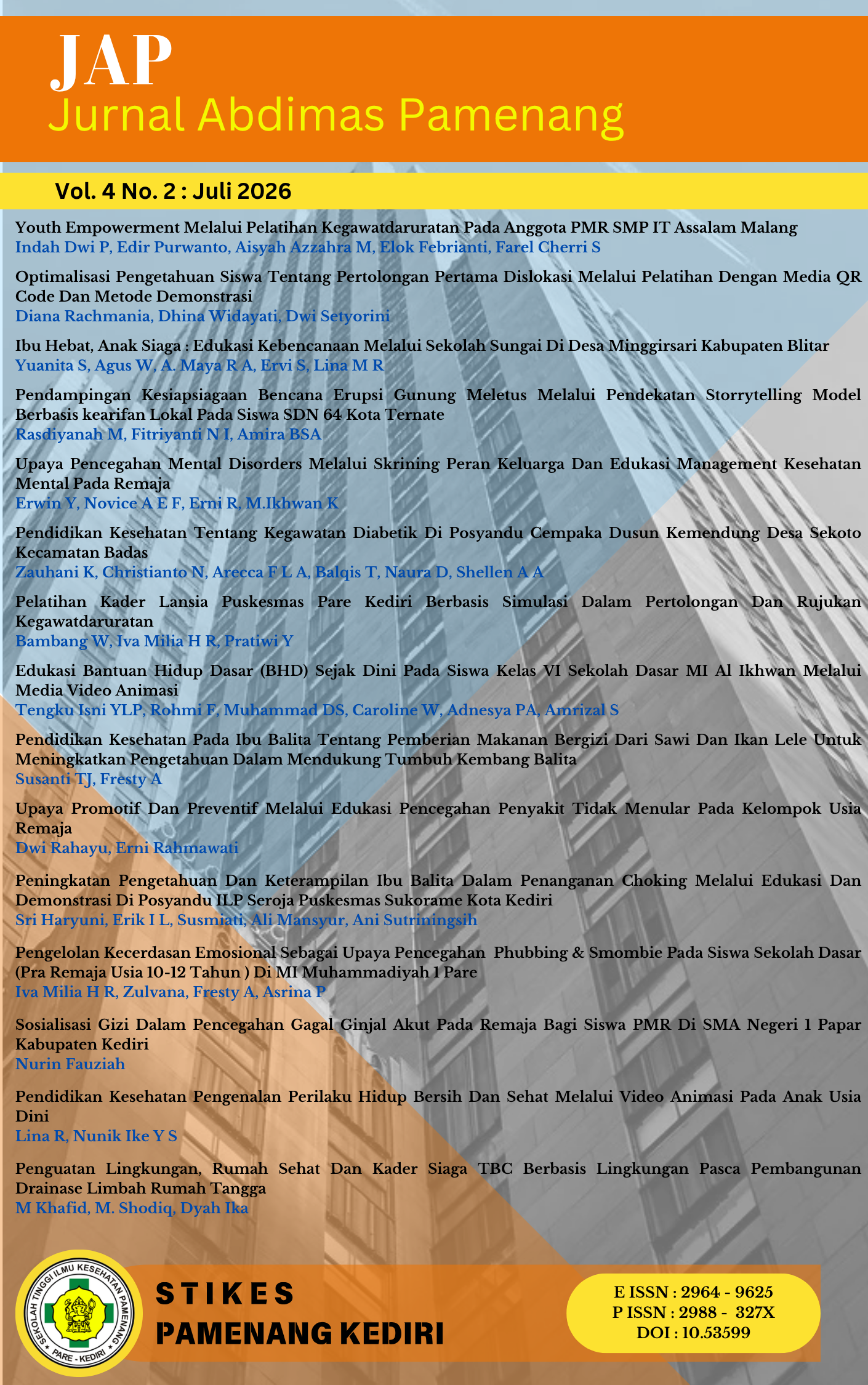
PELATIHAN KADER LANSIA PUSKESMAS PARE KEDIRI BERBASIS SIMULASI DALAM PERTOLONGAN DAN RUJUKAN KEGAWATDARURATAN
SIMULATION-BASED TRAINING OF ELDERLY CADRES AT COMMUNITY HEALTH CENTER (PUSKESMAS) PARE KEDIRI IN EMERGENCY AID AND REFERRAL
DOI:
https://doi.org/10.53599/jap.v4i2.473Keywords:
kader lansia, kegawatdaruratan, pertolongan pertama, sistem rujukan, pelatihan kesehatan masyarakatAbstract
Abstrak
Kegawatdaruratan pada lansia merupakan kondisi yang memerlukan penanganan cepat dan tepat untuk mencegah komplikasi, kecacatan, hingga kematian. Keterbatasan akses layanan kesehatan serta rendahnya pengetahuan masyarakat, khususnya kader kesehatan, menjadi salah satu faktor penghambat dalam penanganan awal kegawatdaruratan di tingkat komunitas. Kegiatan pengabdian kepada masyarakat ini bertujuan untuk meningkatkan kompetensi kader lansia di Puskesmas Pare, Kabupaten Kediri dalam melakukan pertolongan pertama dan rujukan kegawatdaruratan.
Metode yang digunakan adalah pelatihan berbasis teori dan praktik yang meliputi materi identifikasi kondisi gawat darurat pada lansia, prinsip pertolongan pertama, sistem rujukan, serta simulasi kasus. Peserta pelatihan adalah kader lansia yang berada di wilayah kerja Puskesmas Pare. Evaluasi dilakukan melalui pre-test dan post-test untuk mengukur peningkatan pengetahuan serta observasi keterampilan selama praktik.
Hasil kegiatan menunjukkan adanya peningkatan signifikan pada pengetahuan dan keterampilan kader dalam penanganan awal kegawatdaruratan lansia. Rata-rata nilai post-test (56,40) mengalami peningkatan dibandingkan pre-test (78,90) yang menunjukkan efektivitas pelatihan. Didapatkan peningkatan keterampilan dan kemampuan dalam tujukan kasus kegawatdaruratan dengan mampu melakukan identifikasi dini kondisi gawat darurat dan memahami alur rujukan yang tepat.
Kesimpulan dari kegiatan ini adalah pelatihan kader lansia efektif dalam meningkatkan kapasitas kader dalam pertolongan dan rujukan kegawatdaruratan di tingkat komunitas. Diharapkan kegiatan ini dapat berkontribusi dalam menurunkan risiko keterlambatan penanganan kegawatdaruratan pada lansia serta meningkatkan kualitas pelayanan kesehatan berbasis masyarakat.
Abstract
Elderly emergencies require prompt and appropriate treatment to prevent complications, disability, and even death. Limited access to healthcare services and low public knowledge, particularly among health workers, are among the inhibiting factors in initial emergency management at the community level. This community service activity aims to improve the competency of elderly health workers at the Pare Community Health Center in Kediri Regency in providing first aid and emergency referrals.
The method used was theory-based and practical training, covering topics on identifying emergency conditions in the elderly, first aid principles, referral systems, and case simulations. The training participants were elderly health workers within the Pare Community Health Center's work area. Evaluation was conducted through pre- and post-tests to measure knowledge gains and skills observations during the practice.
The results of the activity showed a significant increase in the knowledge and skills of cadres in initial emergency management for the elderly. The average post-test score (56.40) increased compared to the pre-test (78.90), demonstrating the effectiveness of the training. Improved skills and abilities in addressing emergency cases were observed, including the ability to identify emergency conditions early and understand the appropriate referral pathway.
The conclusion of this activity is that the training of elderly cadres is effective in increasing their capacity to provide emergency care and referrals at the community level. It is hoped that this activity will contribute to reducing the risk of delayed emergency care for the elderly and improving the quality of community-based health services.
References
World Health Organization. (2021). Decade of healthy ageing: Baseline report. Geneva: WHO Press.
World Health Organization. (2020). Integrated care for older people (ICOPE): Guidance for person-centred assessment and pathways in primary care. Geneva: WHO.
American Heart Association. (2020). Guidelines for cardiopulmonary resuscitation and emergency cardiovascular care. Circulation, 142(16_suppl_2), S337–S357.
American Red Cross. (2021). First aid/CPR/AED participant’s manual. Washington, DC.
National Institute on Aging. (2022). Aging and health: Emergency preparedness for older adults. Bethesda, MD.
Hazzard's Geriatric Medicine and Gerontology. (2017). New York: McGraw-Hill Education.
Brocklehurst's Textbook of Geriatric Medicine and Gerontology. (2016). Philadelphia: Elsevier.
Oxford Handbook of Emergency Medicine. (2020). Oxford: Oxford University Press.
Kementerian Kesehatan Republik Indonesia. (2020). Pedoman pelayanan kesehatan lanjut usia di fasilitas pelayanan kesehatan. Jakarta: Kemenkes RI.
Kementerian Kesehatan Republik Indonesia. (2019). Pedoman penanggulangan kegawatdaruratan medis di puskesmas. Jakarta: Kemenkes RI.
Perhimpunan Gerontologi Medik Indonesia. (2021). Panduan praktik klinis geriatri. Jakarta.
International Federation on Ageing. (2021). Global guidelines for healthy ageing and emergency preparedness. Toronto.
Centers for Disease Control and Prevention. (2022). Emergency preparedness for older adults. Atlanta, GA.